Why You Keep Forgetting Words (And How Lockcard Fixes It)

I'll never forget the first time I encountered the word "epiphany."
I was watching a YouTube video about creative writing, and the narrator said: "Only twenty minutes to sleep, but you dream of some epiphany." I paused the video. What a beautiful word. I looked it up, saved it in Lockcard, and moved on with my day.
Three days later, I was browsing Quora and there it was again: "An epiphany is not an everyday thing and actually is a result of a deep and philosophical journey of the mind."
Wait. I'd seen this word before.
I clicked on it in Lockcard, and sure enough—"Already Saved 2 times" appeared at the top. Two different contexts. Two different perspectives on the same word. And suddenly, I understood "epiphany" in a way I never could have from just one encounter.
That's when I realized: meeting a word once is just an introduction. Meeting it 8-10 times in different contexts? That's when it becomes yours.
The Science Behind "Meeting" a Word
You know that frustrating feeling when you learn a new word, feel excited about it, and then completely forget it two days later? There's a scientific reason for that.
The 8-10 Encounter Rule
Researchers in vocabulary acquisition have been studying this for decades. Here's what they found:
Paul Nation, one of the most respected researchers in vocabulary learning, conducted a landmark study in 1978 (with Saragi and Meister). The results were striking:
- Words encountered fewer than 6 times: learned by only 50% of learners
- Words encountered 6 or more times: learned by 93% of learners
But it doesn't stop there. Subsequent research painted an even clearer picture:
- Rott (1999): Significant vocabulary growth after 2 exposures, with stronger gains after 6 exposures
- Horst et al. (1998): Target words needed to appear at least 8 times for substantial learning
- Nation and Wang (1999): After 10 encounters, words were far more likely to be truly acquired
- Pigada and Schmitt (2006): Around 10+ exposures led to considerable vocabulary mastery
The Scientific Consensus
To reliably learn a word—its meaning, spelling, pronunciation, and usage—you need to encounter it in different contexts about 8-10 times.
Not 8-10 times staring at the same flashcard. Not 8-10 times reading the same example sentence.
8-10 times in different, real-world contexts.
Why Traditional Methods Fall Short
Let's be honest: most vocabulary learning methods ignore this research completely.
The Flashcard Problem
You make a flashcard:
- Front: "epiphany"
- Back: "a moment of sudden insight or understanding"
You review it 10 times. Same card. Same definition. Same boring example sentence.
Result? You might remember it for a test, but you'll never truly own the word.
The Vocabulary List Problem
Textbooks give you lists of words with one definition and one example sentence. You read it, maybe copy it into a notebook, and... that's it. One encounter. One context.
Result? The word stays abstract. You understand it intellectually, but you can't feel it. You'd never dare use it in conversation.
The Real Issue
These methods treat words like isolated facts to memorize, not living tools to use.
But here's the thing: language isn't learned through memorization. It's learned through repeated, meaningful encounters in varied contexts.
That's exactly what Lockcard was designed to do.
How Lockcard Implements the 8-10 Rule
Let me show you how I learned "epiphany"—and how Lockcard made it effortless.
Encounter #1: YouTube Video
I was watching a video, heard "epiphany," and selected it with Lockcard's browser extension. Instantly, Lockcard saved:
- The word
- The definition
- The full context: "Only twenty minutes to sleep, but you dream of some epiphany."
- The source: YouTube video URL
- The timestamp
What makes this powerful
I didn't just save the word—I saved the moment I encountered it. The context is real, personal, and meaningful.
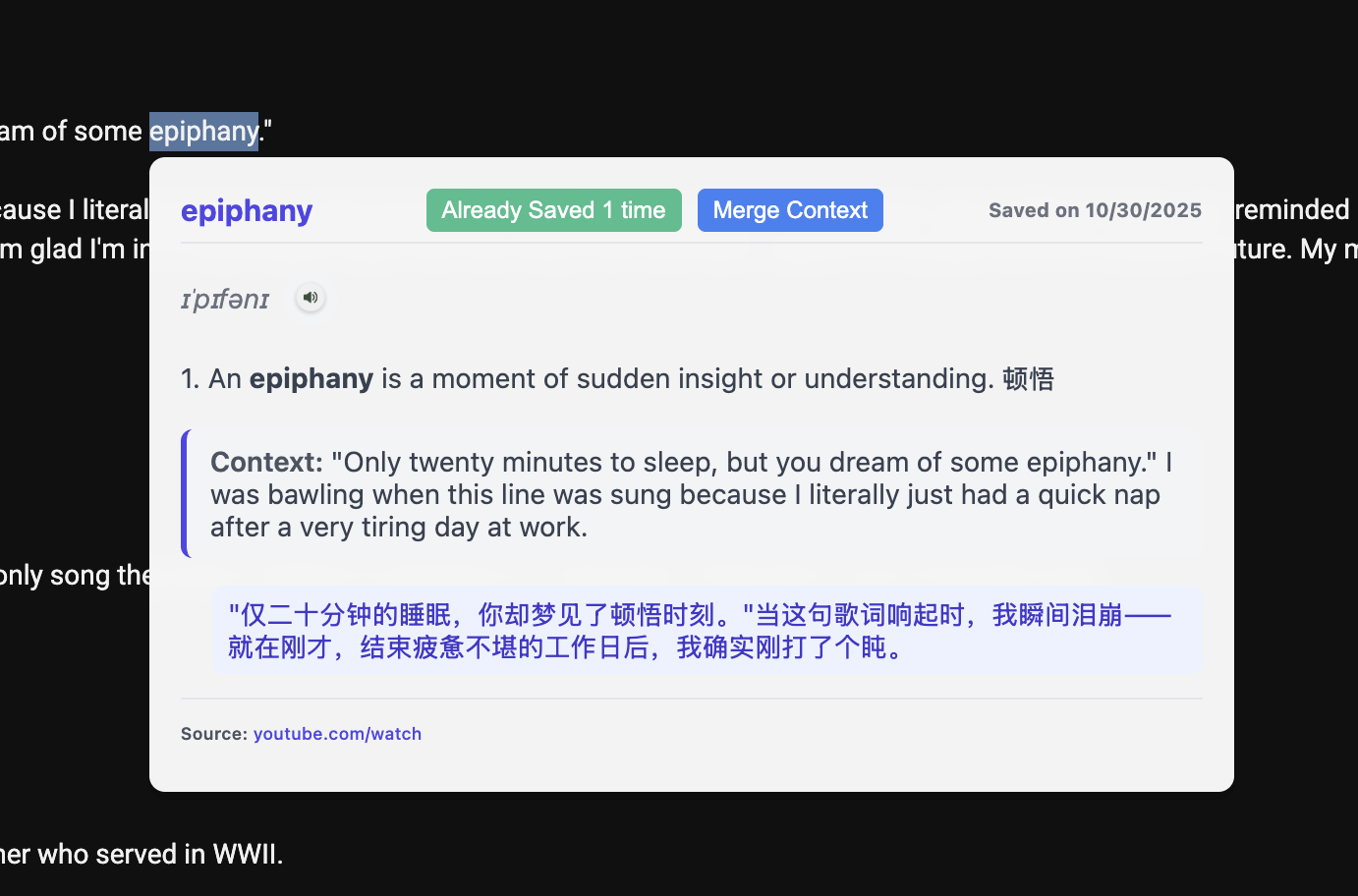
Notice the green badge: "Already Saved 1 time". Lockcard is tracking my journey with this word.
Encounter #2: Quora Article
Three days later, I was reading a Quora answer about creativity. There it was again: "epiphany."
This time, when I clicked on it, Lockcard showed me something magical:
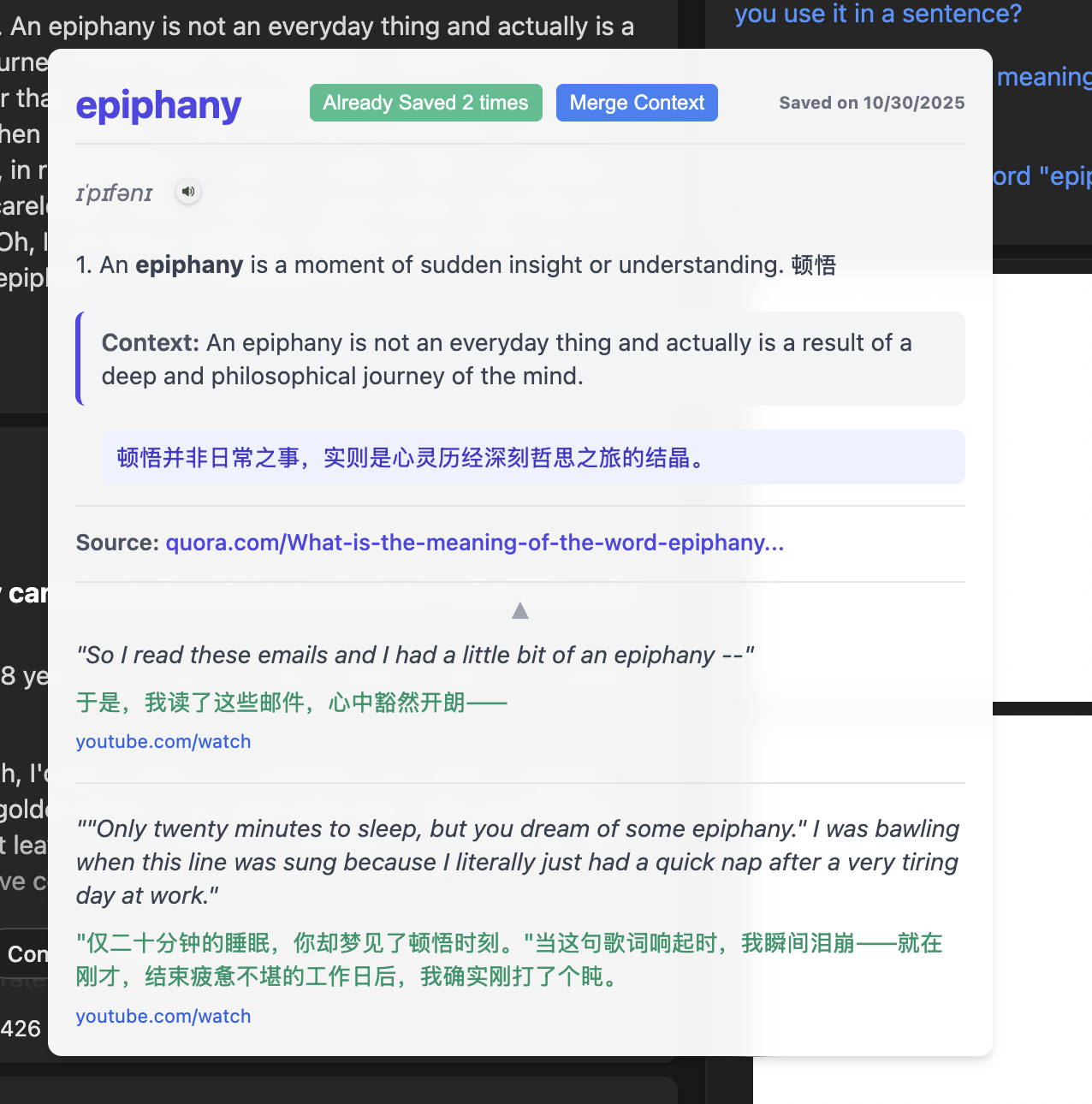
"Already Saved 2 times"
And here's the game-changer: the "Merge Context" button.
With one click, I could see:
- My first encounter (YouTube, talking about dreams and creative insights)
- My second encounter (Quora, talking about philosophical journeys)
- All the context from both sources, side by side
Suddenly, "epiphany" wasn't just a definition—it was a concept I'd seen in action, in two completely different real-world contexts.
Encounters #3-8: Building Mastery
Over the next few weeks, I encountered "epiphany" in:
- A Medium article about product design
- A podcast about startup founders
- An email from a colleague
- A Reddit discussion about learning breakthroughs
- Another YouTube video about scientific discoveries
- A book chapter about historical moments
Each time, Lockcard:
✅ Automatically recognized I'd saved this word before
✅ Tracked the encounter number
✅ Offered to merge the new context
✅ Kept all my previous contexts accessible
By the 8th encounter, something had changed. I wasn't looking up "epiphany" anymore. I knew it. I could use it naturally in my own writing. It had become part of my active vocabulary.
That's the 8-10 rule in action.
The Secret Ingredient: Custom Definitions
Here's where it gets even better.
After my second encounter with "epiphany," I realized something: the dictionary definition was correct, but it didn't capture what the word meant to me.
So I opened the Lockcard iOS app and clicked "Add my own":
Lesen Sie nicht nur Definitionen, schreiben Sie Ihr eigenes Verständnis
Ein Wort wirklich zu beherrschen bedeutet, es mit eigenen Worten erklären und in Sätzen verwenden zu können. Fügen Sie Ihr Verständnis und Beispiele hinzu, um Wörter wirklich zu Ihren eigenen zu machen.
Erstellen Sie Ihre eigenen Sätze
Verbinden Sie Wörter mit Ihren Lebenserfahrungen und verstehen Sie sie im Kontext
Wortarten markieren, um besser zu merken
Nomen, Verb, Adjektiv... verwenden Sie sie präziser
Ideen jederzeit festhalten
Eine gute Definition oder Beispiel gefunden? Einfügen oder scannen
serendipity
synonyms: luck, fortune, chance
The occurrence of events by chance in a happy or beneficial way
I wrote my own definition:
"That 'aha!' moment when everything clicks—not from studying harder, but from seeing the same idea from different angles."
And my own example:
"Reading about spaced repetition 5 times didn't help. But on the 6th encounter, in a totally different context, I had an epiphany about how memory actually works."
This is huge.
Research shows that elaborative encoding—connecting new information to your own experiences and understanding—dramatically improves retention. By writing my own definition and example, I'm not just passively receiving the word. I'm actively making it mine.
Pro tip
Every time you encounter a saved word in a new context, add your new understanding in the app. Each custom note is another encounter—and another step toward mastery.
Why This Works: The Context Effect
Here's what makes Lockcard's approach so effective, according to research:
1. Spaced Repetition (The Natural Way)
Traditional spaced repetition apps schedule reviews for you: "Review this flashcard in 1 day, 3 days, 7 days..."
Lockcard's approach: You encounter words naturally as you read, watch, and browse. The spacing happens organically, based on your real learning journey—not an algorithm's guess.
A 2023 study published in Applied Psycholinguistics found that natural, varied encounters led to better long-term retention than scheduled reviews of the same material.
2. Rich Contextual Learning
When you save a word from YouTube, Lockcard captures:
- The sentence it appeared in
- The video title and URL
- The timestamp
- Your custom notes (if you add them)
When you encounter it again on a website, you add:
- A completely different sentence
- A different topic and context
- Another layer of meaning
Research shows: Words learned in multiple, varied contexts are remembered 3-4 times better than words learned in a single context. (Webb, 2007)
3. The Merge Context Feature
This might be Lockcard's most underrated feature.
When you click "Merge Context," you're not just collecting examples. You're:
- Building a mental network: Each context is a node connected to the central word
- Seeing patterns: You start to understand the word's nuance and range
- Creating personal meaning: This word isn't abstract anymore—it's woven into your real experiences
Cognitive science insight: The brain doesn't store words as isolated units. It stores them as part of a rich network of associations. The more connections, the stronger the memory. (Anderson & Reder, 1979)
The Complete Learning Loop
Here's how a typical word journey looks with Lockcard:
Week 1:
- Day 1: Encounter word on YouTube → Save with context (1st time)
- Day 3: See it again on a blog → Merge context (2nd time)
- Day 5: Find it in an email → Merge again, add custom note (3rd time)
Week 2:
- Day 10: Lockcard widget shows the word → Quick review (4th time)
- Day 12: Encounter in another video → "Oh, I know this one!" (5th time)
Week 3:
- Day 18: Use the word in your own writing → Ultimate test (6th time)
- Day 20: See it again, no need to click—you just know (7th time)
Week 4:
- Day 25: Final encounter, confident usage (8th time)
Result: After 8 varied encounters over 3-4 weeks, the word has moved from "new vocabulary" to "active vocabulary."
And you didn't study. You just lived your life, consumed content you care about, and let Lockcard track your journey.
Real-World Application
Let me show you how this played out for three different learners:
Maria: TOEFL Preparation
Challenge: Needed to learn 500+ academic words for TOEFL
Lockcard approach:
- Read TOEFL practice materials with Lockcard browser extension
- Saved words as she encountered them in context
- Re-encountered many words naturally across different practice tests
- Added custom examples from her own life
- Used merge context to build comprehensive understanding
Result: Average of 7-9 encounters per word over 2 months.
Her insight: "I stopped trying to memorize 500 words. I just read, saved what I didn't know, and trusted the process. Words I'd seen 8+ times felt automatic on test day."
James: Business English
Challenge: Needed professional vocabulary for international meetings
Lockcard approach:
- Saved terms from business articles, podcasts, and email threads
- Added his own examples using actual work scenarios
- Encountered words repeatedly in different business contexts
Result: Within 3 months, comfortably used advanced business vocabulary in meetings and presentations.
His insight: "When I write my own examples from real work situations, I'm not learning abstract words—I'm learning MY vocabulary for MY job. That changed everything."
Yuki: Learning Through Passion
Challenge: Intermediate learner, lost motivation with traditional methods
Lockcard approach:
- Saved words from cooking videos (her hobby)
- Encountered vocabulary naturally while pursuing her interest
- Extended to other topics as confidence grew
Result: Built a rich, practical vocabulary without "studying"
Her insight: "I'm not 'studying English' anymore. I'm watching videos I love and getting smarter. Lockcard just keeps track of my progress."
Your Turn: Start Building Your 8-10 Encounters
Ready to experience the difference?
Here's how to get started:
Step 1: Just Save It
When you encounter a new word you want to learn, save it with Lockcard. Don't overthink it. Just click and save.
What Lockcard captures:
- The word
- The context (full sentence)
- The source (URL, timestamp if from video)
- The date
Step 2: Add Your Own Understanding
Open the word in the Lockcard iOS app and click "Add my own." Write:
- Your own definition (in your own words)
- Your own example sentence (from your life)
- Any notes that help you remember
Step 3: Let Life Do the Work
Don't force it. Keep reading, watching, and browsing content you care about. When you encounter the word again:
- Lockcard will show you "Already Saved X times"
- Click "Merge Context" to add this new encounter
- Watch your understanding deepen
Step 4: Trust the 8-10 Rule
After 8-10 varied encounters, you'll notice:
- You stop looking up the word
- You recognize it instantly when reading
- You start using it in your own writing
- It feels natural, not forced
That's mastery.
The Bottom Line
Here's what research tells us:
- One encounter: You might recognize the word tomorrow
- Three encounters: You'll remember it for a week
- 6-8 encounters: You'll know it when you see it
- 8-10 encounters: It's yours. Permanently.
And here's what Lockcard does:
- ✅ Tracks every encounter automatically
- ✅ Captures rich, real-world context
- ✅ Merges multiple contexts into one comprehensive view
- ✅ Lets you add personal meaning and examples
- ✅ Makes the 8-10 rule effortless
You don't need to memorize harder. You need to meet words more—in different places, different contexts, different moments.
Lockcard turns that scientific insight into something you can actually use.
Start Your Journey
The word "epiphany" took me about 3 weeks and 9 encounters to truly master. Now, months later, I use it regularly. It's part of my active vocabulary.
And I didn't "study" it once.
That's the power of learning with science, not against it.
Ready to experience it yourself?
Try it now: Save your next unknown word with Lockcard and watch your first encounter become part of a bigger journey. Download Lockcard and start building your 8-10 encounters today.
Join 50,000+ learners who've stopped forgetting words and started truly mastering them.
References
This article is based on extensive research in vocabulary acquisition and spaced repetition:
-
Saragi, T., Nation, I. S. P., & Meister, G. F. (1978). Vocabulary learning and reading. System, 6(2), 72-78. [The foundational study showing 6+ encounters lead to 93% acquisition rate]
-
Rott, S. (1999). The effect of exposure frequency on intermediate language learners' incidental vocabulary acquisition and retention through reading. Studies in Second Language Acquisition, 21(4), 589-619.
-
Horst, M., Cobb, T., & Meara, P. (1998). Beyond a clockwork orange: Acquiring second language vocabulary through reading. Reading in a Foreign Language, 11(2), 207-223.
-
Nation, I. S. P., & Wang, K. (1999). Graded readers and vocabulary. Reading in a Foreign Language, 12(2), 355-380.
-
Pigada, M., & Schmitt, N. (2006). Vocabulary acquisition from extensive reading: A case study. Reading in a Foreign Language, 18(1), 1-28.
-
Webb, S. (2007). The effects of repetition on vocabulary knowledge. Applied Linguistics, 28(1), 46-65. [Demonstrated that multiple contexts improve retention by 3-4x]
-
Anderson, J. R., & Reder, L. M. (1979). An elaborative processing explanation of depth of processing. In L. S. Cermak & F. I. M. Craik (Eds.), Levels of processing in human memory (pp. 385-403). Hillsdale, NJ: Erlbaum. [Cognitive science foundation for elaborative encoding]
-
Applied Psycholinguistics (2023). Effect of context on the processing and learning of novel L2 vocabulary while reading. Cambridge University Press. [Recent study on natural vs. scheduled repetition]
For more information on vocabulary acquisition research, see Professor Paul Nation's work at Victoria University of Wellington: https://www.wgtn.ac.nz/lals/about/staff/paul-nation
