Why I Abandoned My English Learning Blog (The Truth No One Talks About)

Two years ago, I decided to write an English learning series.
I was going to call it something ambitious like "The Complete English Mastery Guide" or "Your Roadmap to Fluency." I had it all planned out:
- Module 1: Pronunciation and Accent Training
- Module 2: Vocabulary Building Strategies
- Module 3: Reading Comprehension Techniques
- Module 4: Listening Skills Development
- Module 5: Speaking Confidence
- Module 6: Writing Mastery
- Module 7: Grammar in Context
- Module 8: ...
Twenty articles. Maybe more. I had notes everywhere. I'd tried every method myself: shadowing exercises, extensive reading programs, listening-first approaches, grammar drills, pronunciation apps, language exchange partners.
I felt qualified. I had opinions. I had experience.
I opened a blank document and started typing.
Module 1: Pronunciation and Accent Training
I wrote a few paragraphs. Then I paused. Something felt off.
I moved to Module 2: Vocabulary Building Strategies.
I wrote more. But with each paragraph, the feeling grew stronger. A nagging sense that I was... overcomplicating things.
I tried Module 3. Module 4. Each time, I found myself writing the same core advice in different words.
And then I stopped.
Not because I ran out of ideas. Not because I got busy. Not because I lost motivation.
But because I realized something that made continuing impossible.
The One-Sentence Secret
Everything I wanted to say—every module, every technique, every strategy—could be reduced to one sentence:
"Put words into sentences."
That's it.
That's the entire secret to learning English.
Not "learn 5000 words."
Not "master 12 tenses."
Not "improve your accent."
Not "read for 30 minutes daily."
Just: Put words into sentences.
And suddenly, my 20-module plan collapsed:
- "How to improve pronunciation?" → Put words into sentences (by speaking them)
- "How to expand vocabulary?" → Put words into sentences (as you encounter them)
- "How to practice speaking?" → Put words into sentences (out loud)
- "How to improve writing?" → Put words into sentences (on paper)
- "How to develop listening skills?" → Understand words in sentences (in real speech)
- "How to master grammar?" → See words in sentences (in context)
Everything was the same answer.
How do you write 20 articles about something that simple?
The Observation That Led Me Here
But here's the thing: I didn't arrive at this realization in a flash of insight while sitting at my desk.
I discovered it while preparing to write the blog.
As I was outlining my 20 modules, I was also paying attention to how people around me—fluent speakers, language learners, colleagues—actually dealt with new words in real life.
I watched. I listened. I took notes.
And slowly, a pattern emerged. A pattern so consistent, so obvious in hindsight, that it made all my elaborate "modules" feel unnecessary.
Let me show you what I saw.
Story #1: The Nigerian Colleague
My colleague from Nigeria—let's call her Ada—is reading a news article at her desk.
Suddenly, she pauses. Her cursor stops moving.
"Ajar..." she mutters to herself. "What is ajar?"
I watch her (probably a bit creepily, but I was in my observation phase). She opens Google. Types "ajar." Reads the definition:
"ajar (adjective): (of a door or window) slightly open"
She stares at the definition for maybe two seconds.
And then—and this is the part that changed everything for me—she turns toward the office door, which happens to be slightly open, points at it, and says out loud:
"The door is ajar."
She says it again, looking directly at the door: "The door is ajar."
Then she pulls out her notebook—an old-school paper notebook with a worn cover—and writes something down.
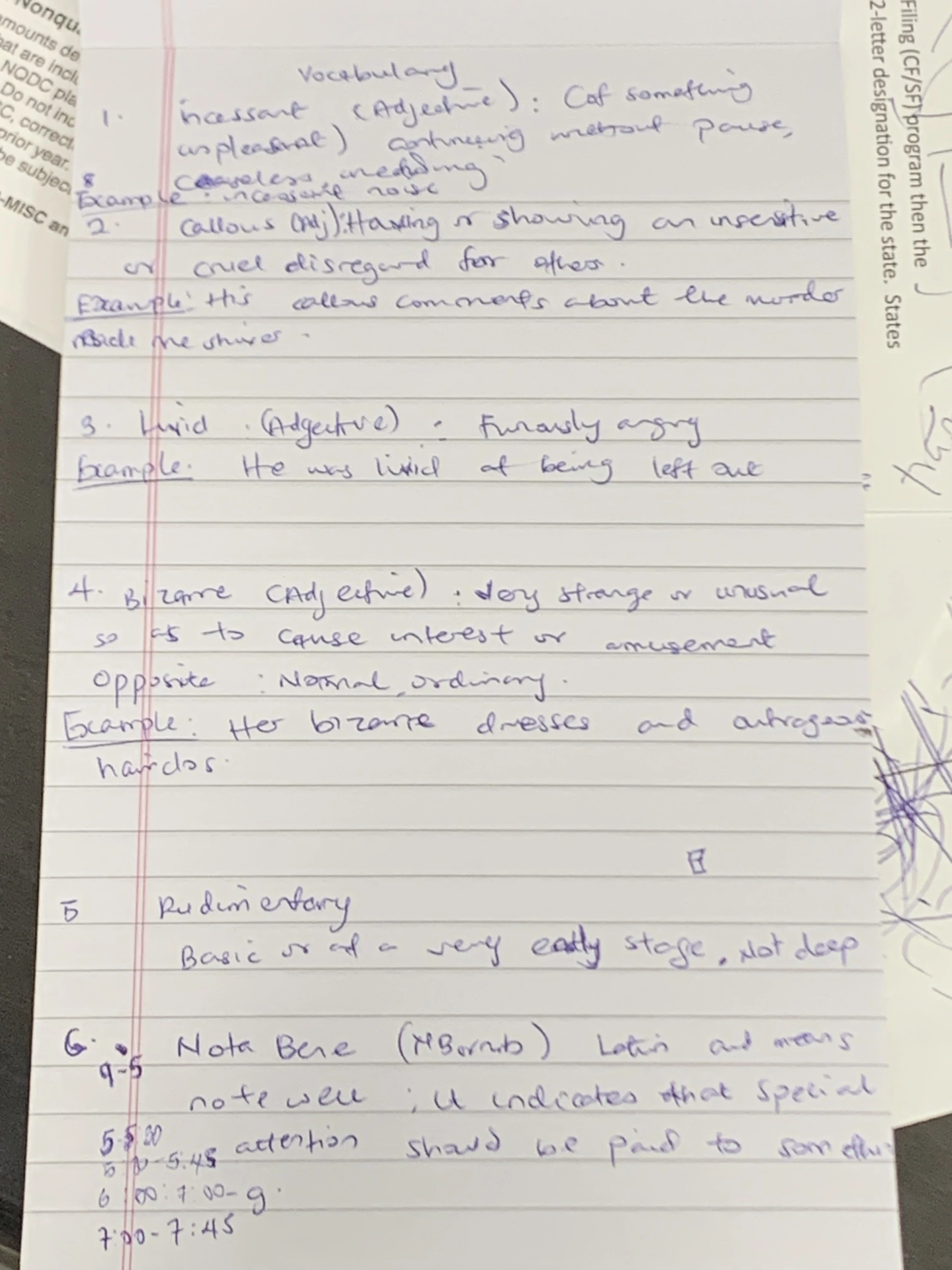
I leaned over slightly and saw what she wrote:
Not just the word.
Not just the definition.
The sentence: "The door is ajar."
Along with her own note about the context.
"That's how I learn," she said, noticing me looking. "I see a word, I make a sentence. Otherwise, I forget."
That was it.
No flashcards. No repetition drills. No "I need to review this 7 times with spaced repetition." No adding it to a todo list to "practice later."
She encountered a word.
She understood the meaning.
She put it in a sentence—immediately—about something real in front of her.
She wrote it down.
She moved on with her life.
And you know what?
A week later, I heard her use "ajar" naturally in a meeting: "Can someone close that window? It's ajar and the AC is on."
It was her word now. Completely natural. No hesitation.
One encounter. One sentence. Done.
Story #2: The Native Speaker
Scene: ACM algorithm study group, Saturday afternoon
I'm sitting with a group of developers working through algorithm problems. One of them is a native English speaker from the US—let's call him Jake. Smart guy, computer science major, articulate, confident.
We're reading through a problem statement when we hit a word none of us know. Not even Jake.
He stops. "Wait, what does [word] mean?"
(I genuinely can't remember what the word was. I'll explain why in a moment.)
I watch him pull out his phone. He Googles it immediately.
Here's what's interesting: He reads the English definition. And he reads the example sentences.
He's a native speaker. English is his first language. But he's learning this word the same way I would—by looking at how it's used.
"Oh," he says, reading. "So it's like when [creates his own example related to the algorithm problem]."
Then he explains it to the rest of us using his own example, connected to the context we're working in.
A native speaker. Learning a new word. By putting it in a sentence.
Not by memorizing a definition. Not by reading it 10 times. By creating usage. By making meaning.
Now, here's the interesting part:
I don't remember what that word was.
Not because my memory is terrible. But because I've never encountered that word again since that Saturday afternoon.
It's been over two years. That word hasn't appeared in any article I've read, any video I've watched, any conversation I've had, any code documentation I've reviewed.
It was probably some obscure technical term or academic vocabulary that sounded important but had no real use in daily life.
And that taught me something crucial:
If you learn words you never actually encounter in your real life, you'll forget them. No matter how many times you reviewed them. No matter how many flashcards you made.
Because learning isn't about forcing random words into your brain. It's about capturing the words that naturally appear in your world.
That's what Lockcard is built for—not to teach you someone else's word list, but to help you learn the words you actually meet.
The Pattern I Couldn't Unsee
After watching Ada and Jake, I started seeing the same pattern everywhere:
Every fluent speaker I observed did the same thing:
- Encounter word in real context
- Understand the meaning
- Immediately create their own sentence (out loud or in writing)
- Move on
That's it. That's the pattern.
No complex system. No 7-step process. No elaborate study schedule.
Just: word → meaning → sentence → done.
Why Does This Work?
Here's what I understand now:
Your brain doesn't store words. It stores usage.
Think about it:
When you memorize:
gregarious = sociable, outgoing
Your brain has:
- ❌ A definition
- ❌ A translation
- ❌ An abstract concept
But when you create:
"My roommate is so gregarious, he makes friends in the elevator."
Your brain has:
- ✅ The meaning (sociable, outgoing)
- ✅ The context (describing a person)
- ✅ The grammar (adjective, before a noun)
- ✅ The feeling (slight exasperation, but fondness)
- ✅ A memory anchor (your actual roommate)
- ✅ The usage pattern (how native speakers would use it)
One sentence contains everything. A word alone contains nothing.
When Ada said "The door is ajar," she wasn't just memorizing a definition. She was creating a memory that included:
- The visual (seeing the actual door)
- The spatial context (office door, slightly open)
- The grammatical structure (noun + verb + adjective)
- The real-world scenario (something she might actually say)
That's why she remembered it after one encounter. The sentence created a complete, rich, multi-sensory memory.
A flashcard with "ajar = slightly open" would have been forgotten by the next day.
The Math That Changed My Mind
Let me ask you something:
If you can make sentences with 100 words, can you speak English?
Probably a little, right? Very basic conversations. "I am hungry." "The book is red." "I like coffee."
What about 1,000 words?
Now we're talking. You can express most daily ideas, handle most common situations, have real conversations about your life.
What about 10,000 words?
That's near-native fluency. That's complex discussions, nuanced thoughts, creative expression, understanding movies without subtitles.
But here's the key—and this is crucial:
I didn't say "if you know 10,000 words."
I said "if you can make sentences with 10,000 words."
The difference is everything.
You can "know" 10,000 words—recognize them when you see them, understand them when you hear them—and still struggle to speak.
Because knowing and using are completely different skills.
But if you can make sentences with 10,000 words? You're fluent. Period.
Test yourself right now:
Think of a word you "know"—maybe from a vocabulary list, a flashcard app, or a test you studied for.
Now, without looking anything up, make a sentence with it. A real sentence. Something you might actually say.
Can you?
If you hesitated, if you weren't sure about the grammar, if the sentence felt unnatural—that's a word you "know" but can't use.
Now think of a word you use all the time.
Can you make 10 different sentences with it? Probably instantly, without even thinking.
That's the difference.
The Wrong Words vs. The Right Words
This connects to something else I discovered:
We spend so much time learning negative words—words we think we should know.
- Academic word lists
- "1000 most common words"
- TOEFL vocabulary
- IELTS preparation lists
- "Words every educated person should know"
Someone else decided these words were important. Someone else made the list. Someone else thought you needed them.
But here's the truth:
You don't need to learn words you'll never encounter in your actual life.
You need to learn passive words—words that naturally show up in your world.
- The YouTuber you watch talks about "epiphany" → That's YOUR word
- Your favorite podcast mentions "pragmatic" → That's YOUR word
- Your colleague uses "ajar" → That's YOUR word
- The article you're reading uses "meticulous" → That's YOUR word
These are real words from your real life. In real sentences. In real contexts that matter to you.
That's why Jake forgot that obscure algorithm term. It never appeared in his real world again. It was a negative word—something that seemed important in that moment but had no actual presence in his life.
And that's why Ada remembered "ajar." She saw it in the office. She used it in a meeting. It was connected to her real environment.
This is why Lockcard exists.
Not to drill you on someone else's word list.
Not to make you memorize "1000 essential words."
But to capture the words YOU actually encounter—in YouTube videos you watch, articles you read, conversations you have.
Your words. Your contexts. Your sentences.
How to Actually Do This
Okay, enough theory. How do you actually "put words in sentences"?
The moment you encounter a new word:
Step 1: Understand It
Google it. Use a dictionary. Read the definition and examples. Get the meaning clear.
Step 2: Create Your Sentence Immediately
Don't wait. Don't add it to a "review later" list. Right now, out loud or written down, make a sentence.
Important: Use your real life. Make it about something you might actually say.
Step 3: Say It Like You Mean It
Don't just recite mechanically. Use the word as if you're really communicating something.
Examples:
❌ Bad:
- "Serendipity means happy accident."
- "Meticulous = very careful."
- "The man is gregarious."
✅ Good:
- "Finding Lockcard was pure serendipity—I wasn't even looking for a vocabulary app."
- "My manager is meticulous about PR reviews; every commit needs detailed documentation."
- "My roommate is so gregarious he makes friends in the elevator."
What makes the good examples good?
- ✅ They're about real things (Lockcard, your manager, your roommate)
- ✅ They're sentences you might actually say
- ✅ They're specific and concrete, not generic
- ✅ They sound natural, not forced
The Lockcard Way
Here's what makes Lockcard perfect for this method:
When you save a word from a YouTube video or article, you're already saving it in a sentence—the real sentence where you found it.
That's encounter #1. Context #1. Sentence #1.
Then you open the Lockcard app and click "Add my own."
You write your own sentence. Your own example. Your own meaning.
That's encounter #2. Context #2. Sentence #2.
Now you have TWO sentences. Two uses. Two memories. Two contexts.
And as you encounter the word again in other videos, articles, or conversations, you click "Merge Context" and add those sentences too.
You're not studying. You're collecting real usage from your real life.
Why This Is Simple But Not Easy
Let me be honest:
This method is simple. But it's not easy.
It's much easier to:
- ❌ Download a pre-made flashcard deck
- ❌ Review 50 definitions in 10 minutes
- ❌ Feel productive because you "studied"
It's harder to:
- ✅ Actually think of a real sentence
- ✅ Use the word yourself, in your own words
- ✅ Create original meaning, not just memorize
But here's what I learned:
Reviewing 50 flashcards feels productive.
Using 5 words in real sentences IS productive.
One creates the illusion of learning.
The other is learning.
I've seen so many language learners who can recognize 5,000 words but can't have a basic conversation.
Why? Because they know definitions, not usage. They have words, not sentences.
And I've seen learners with smaller vocabularies who speak fluently and confidently.
Why? Because every word they know, they can use. They have sentences, not just words.
You don't need more words. You need more sentences.
Back to the Blog
So that's why I never finished my English learning series.
How could I write 20 detailed modules when the answer fit in one sentence?
- Module 1 (Pronunciation): Put words into sentences by speaking them out loud
- Module 2 (Vocabulary): Put words into sentences as you encounter them
- Module 3 (Reading): Understand words in sentences in written form
- Module 4 (Listening): Understand words in sentences in spoken form
- Module 5 (Speaking): Put words into sentences in conversation
- Module 6 (Writing): Put words into sentences on paper
Every module was the same answer. Put words into sentences.
I felt like I was writing the same article 20 times with different titles.
But here's the thing:
Just because the answer is simple doesn't mean it's easy.
Just because I can tell you in one sentence doesn't mean you'll do it.
Just because it's obvious doesn't mean most people practice it.
The real challenge isn't knowing what to do.
The challenge is doing it—with every word, every time, without shortcuts.
Your Turn
Next time you encounter a word you don't know, try this:
Don't just read the definition.
Don't just add it to a review queue.
Don't just save it for later.
Put it in a sentence. Right now. Out loud. About your real life.
Do that 100 times, you'll have 100 usable words.
Do that 1,000 times, you'll speak English confidently.
Do that 10,000 times, you'll be fluent.
It's that simple.
And that hard.
And that worth it.
Because here's the truth:
You don't become fluent by knowing a lot of words.
You become fluent by using a lot of words.
And you can't use words you haven't put in sentences.
The Tool That Makes This Natural
This is why Lockcard exists.
When you watch YouTube and encounter "epiphany," Lockcard captures:
- ✅ The word
- ✅ The sentence it appeared in (real context)
- ✅ The source (video URL and timestamp)
- ✅ Your custom sentence (in "Add my own")
When you see "epiphany" again in a different video or article, Lockcard:
- ✅ Shows you "Already saved 2 times"
- ✅ Lets you merge the new context
- ✅ Tracks your journey with this word across multiple real encounters
You're not learning negative words from someone else's list.
You're learning passive words from your own life.
And every time you add your own sentence, you're practicing the one method that actually works: putting words into sentences.
Try it now
Save your next unknown word with Lockcard. Write your own sentence in "Add my own." Watch how much faster you remember it compared to any flashcard app you've ever used.
Join 50,000+ learners who stopped memorizing definitions and started making sentences.
Final Thought
I never finished that English learning blog.
But maybe I just wrote the only article it needed.
Put words into sentences.
Everything else is commentary.
References
This article draws on observations of language acquisition across native and non-native speakers, supported by research in usage-based linguistics:
-
Tomasello, M. (2003). Constructing a Language: A Usage-Based Theory of Language Acquisition. Harvard University Press. [Foundational work on how language is learned through usage patterns, not isolated words]
-
Ellis, N. C. (2002). Frequency effects in language processing and acquisition. Studies in Second Language Acquisition, 24(2), 143-188. [Demonstrates that words learned in context are retained better than isolated vocabulary]
-
Nation, I. S. P. (2001). Learning Vocabulary in Another Language. Cambridge University Press. [Emphasizes the importance of encountering words in meaningful contexts]
-
Wray, A. (2002). Formulaic Language and the Lexicon. Cambridge University Press. [Shows how fluent speakers store and use language in multi-word units, not individual words]
-
Schmitt, N. (2008). Instructed second language vocabulary learning. Language Teaching Research, 12(3), 329-363. [Reviews effective vocabulary learning strategies, emphasizing contextual usage]
-
Laufer, B., & Hulstijn, J. (2001). Incidental vocabulary acquisition in a second language: The construct of task-induced involvement. Applied Linguistics, 22(1), 1-26. [Demonstrates that active production (like sentence creation) leads to better retention]
For more on usage-based approaches to language learning, see the work of Michael Tomasello at Duke University and Nick Ellis at University of Michigan.
